“My aim is to put down on paper what I see and what I feel in the best and simplest way.”
― Ernest Hemingway
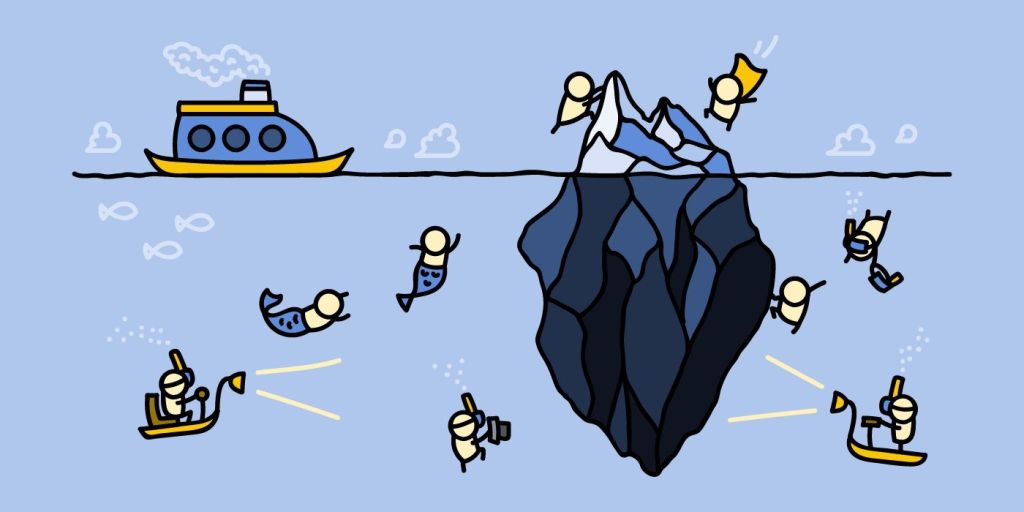
In my work with social purpose projects, I often come across images of icebergs as a metaphor for what is unseen, alongside advice and guidance advising that we should ‘lower the waterline’. Only by making visible what is otherwise hidden can we make sense of what is seen, apparently.
But do you know that exposing everything that is unseen is exactly the opposite of the intentions of Ernest Hemmingway, the 20th Century American author’s intention when he coined his ‘Iceberg Theory’?
In ‘Death in the Afternoon’, Hemmingway said “If a writer of prose knows enough about what he is writing about, he may omit things that he knows and the reader, if the writer is writing truly enough, will have a feeling of those things as strongly as though the writer had stated them. The dignity of movement of an iceberg is due to only one-eighth of it being above water”
How can I take this on board whilst writing up the evaluation I’ve been working on? We want people to take what we say about the project interventions seriously. We need credibility, facts and data, don’t we? But a lengthy report brimming with methodological detail and pages of data, frankly, is not impactful for the reader or for the people who did the project.
Unfortunately Hemmingway offers conflicting (perhaps) advice. “There’s no one thing that’s true. It’s all true.” he says, but also, “All you have to do is write one true sentence. Write the truest sentence that you know.”
..I saw joy on the faces of the people who participated in the project. I saw, in what they said and what they wrote, that they were deeply touched by what they had been part of, and wanted to do more.. – Antworks Community 2025
 Antworks Community
Leave a comment